Google Ads Strategy:
What Pausing Your Campaign
Really Costs You
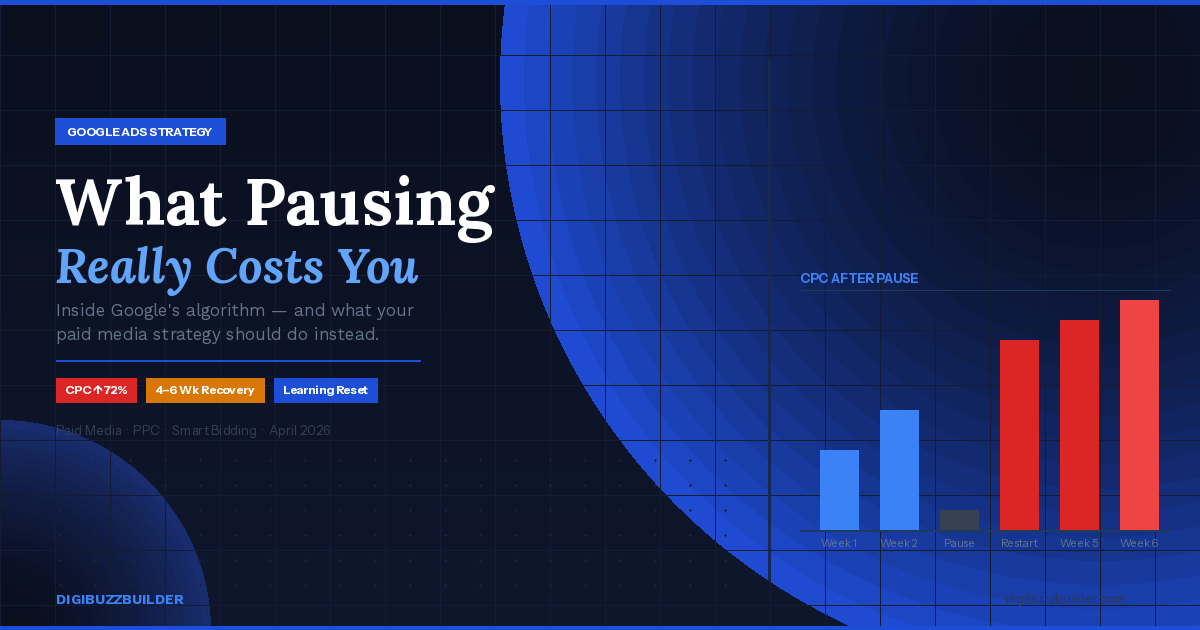
A pause feels like a harmless timeout. Inside Google’s auction engine, it’s anything but. Here’s what’s really happening — and what your Google Ads strategy should do instead.
✍️ Paid Media Strategist📅 April 3, 2026⏱️ 6 min read

A smart Google Ads strategy lives and dies on consistency. Yet pausing campaigns is one of the most common — and most costly — mistakes businesses make with their paid media. If you’ve ever hit pause “just for a few weeks” and come back to find everything broken, this article is for you. Understanding what happens inside Google’s algorithm when your Google Ads strategy goes dark is the first step to protecting it.
📍 Sound Familiar?
“Your campaign has been running for two months. Results were decent — leads coming in, CPCs manageable. Then budget gets tight and you hit pause. Six weeks later you turn it back on. And nothing works the same way anymore.”
CPCs are up. Conversion rates dipped. The campaign feels like it’s starting from scratch — except it’s actually worse than starting from scratch in some ways. Most marketers don’t fully understand why that happens. Let’s get into it.
3–7
Days before algorithm re-learning begins
72%
Higher CPCs reported in first 2 weeks post-restart
4–6 wks
Average time to recover pre-pause performance
01 — Algorithm Impact
What Pausing Does to Your Google Ads Strategy Algorithm
Google’s Smart Bidding algorithms — whether you’re using Target CPA, Target ROAS, or Maximize Conversions — are the engine behind any effective Google Ads strategy. They’re constantly learning. Every impression, click, and conversion feeds the model. The system builds a precise picture of who converts, when, on which device, at what time of day.
When you pause, that data stream stops. And it doesn’t just freeze — it goes stale. Google’s auction models are dynamic. Market conditions shift, competitor bids change, user behaviour evolves. Your campaign data from six weeks ago is already a less accurate predictor than it was when you paused. So when you restart, the algorithm isn’t resuming — it’s essentially re-learning, but with outdated signals as its foundation.
Why It Matters
Google officially acknowledges a “learning phase” that kicks in after significant changes — and pausing for more than a few days is treated as a significant change. During this phase, performance is inconsistent and CPCs often spike as the algorithm recalibrates. Any well-builtGoogle Ads strategymust account for this cost.
02 — Auctions & Visibility
How Pausing Damages Your Google Ads Strategy Auction Standing
Here’s where it gets interesting. Google Ads isn’t a fixed marketplace — you’re in constant competition with other advertisers every single time someone searches. Your Quality Score, Ad Rank, and historical CTR all factor into how you compete and how much you pay per click.
When your ads go dark, your competitors don’t pause with you. They keep running, keep accumulating clicks and conversions, keep refining their campaigns. Some may even step in to capture the budget you vacated. By the time you’re back, they’ve built momentum you’ll need to earn back — and your Google Ads strategy will pay for it.
“Your competitors didn’t pause. While your campaign was dark, they were winning the auctions you used to win — and they got smarter doing it.”
Visibility loss compounds too. If you’ve been running display or remarketing campaigns alongside search, pausing breaks your remarketing windows. Users who visited your site last week start falling out of your audience lists. Your brand presence in the ecosystem weakens — and that affects even your organic performance indirectly.
03 — CPC Efficiency
Why CPC Rises After You Pause Your Google Ads Strategy

Your historical Quality Score carries weight — but it fades. A well-performing Google Ads strategy that’s been dormant for several weeks loses some of its earned efficiency. When you come back, Google treats you with less confidence — you’re an unknown quantity again in some respects.
Real-World Example
A mid-size e-commerce client in the home décor space paused their shopping campaigns for five weeks during a stock issue. Before pausing, their average CPC was around ₹18. When they restarted, it climbed to ₹31 within the first two weeks. Same keywords. Same budgets. The algorithm was simply rebuilding trust — and that rebuilding process costs real money.
This isn’t Google penalising you — it’s just how auction mathematics work. Less data confidence equals less efficient bidding. The system bids more conservatively (but often at higher CPCs) until it regains clarity. And that clarity takes weeks, sometimes longer for competitive niches.
04 — When Pausing Is Justified
When Pausing Actually Fits Your Google Ads Strategies
None of this means pausing is always wrong. There are genuinely good reasons to stop a campaign as part of a considered Google Ads strategy:
Acceptable Pause Scenarios
Your landing page is down or being rebuilt significantly · You’re pivoting your marketing strategy and current creative is actively misleading · You’re in a seasonal business and truly out of inventory · You’re running a structured A/B test · Budget has been completely exhausted with no near-term replenishment.
Even in these cases, be intentional about timing. A pause of 1–3 days is fairly recoverable. Beyond a week, you’re looking at measurable re-learning impact. Beyond three weeks, plan for a restart that essentially behaves like a new campaign.
05 — Smarter Alternatives
What Your Google Ads Strategy Should Do Instead of Pausing
If budget is the main driver, there are better levers to pull. Pausing is the bluntest instrument available — and usually not the most effective one. A smarter Google Ads strategy protects algorithm momentum while managing spend.
- 📉Reduce daily budget by 30–50%Keeps the algorithm fed, just on a smaller diet. Signal flow continues uninterrupted.
- 🎯Tighten audience targetingCut low-converting segments rather than going dark entirely.
- ✂️Pause underperforming ad groupsSurgical pausing at ad group level is far less damaging than campaign-level stops.
- ⚙️Lower target CPA or ROAS targetsNaturally restricts spend while keeping the learning loop alive.
- 🕐Use daypartingRun ads only during proven high-conversion windows to stretch limited budgets.
Agency Insight
A good digital marketing agency will typically run through these options before recommending a full pause. The goal is to protect your algorithm’s investment — because that’s exactly what it is. Weeks of learning that took real budget to build.
Trend Watch
Automation Is Raising the Stakes on Your Google Ads Strategies

As Google pushes further into AI-driven campaign structures — Performance Max, broad match with Smart Bidding, automated creative testing — consistency is becoming more critical than ever. The entire model of modern Google Ads strategy on Google is built on continuous signal flow. Disrupting that flow is increasingly costly.
Performance Max campaigns run across Search, Display, YouTube, Discover, and Gmail simultaneously. The algorithm needs to understand your customer across all those surfaces. Pausing doesn’t just interrupt Search — it interrupts everything. The more sophisticated your campaign structure, the more you have to lose from a cold stop.
For businesses serious about lead generation, this also connects to broader channel thinking. If your Google Ads strategy goes dark even temporarily, that gap in top-of-funnel activity hits your pipeline downstream — including your email marketing lists that depend on fresh incoming leads. It’s all connected. Which is why treating Google Ads like a light switch is such an expensive habit.